Showing posts with label Army Memoirs. Show all posts

Tuesday, August 20, 2019

My Swiming Lessons

A non swimmer can enter the Indian Army but the Army won't allow one to remain a non swimmer for long. Once again owing to having been born and brought up at Shimla, I did not know swimming when i entered Army and also was not imparted training in swimming in the OTA because the swimming pool had just been inaugurated as we were passing out from the Officers' Training Academy. I tried my hand in swimming at our regimental centre where i stayed for about fifteen days before reporting to my unit in Nagaland. During the swimming practice in the regimental centre swimming pool i would swim the full length but only by holding my breath as i could not establish coordination between my strokes and my breathing. While the instructors would admonish me for not making the right moves they would also express surprise over my capacity to hold my breath for so long under water.

Luckily i was deputed to undergo a course in Physical Training at Army School of Physical Training, Pune within just three months of my reporting to my Unit. There it was that i learnt full fledged swimming. I along with some other officers was declared weak swimmer and would have to go for swimming practice in addition to attending the regular training schedule. It was quite an embarrassing  experience, not because we were singled out as weak swimmers but because three grown up daughters (almost our age) of the Commandant of the ASPT also used to come for swimming at the same time.  While their presence in the swimming pool offered a pleasant company to us young bachelor officers in our early twenties, it also threw a challenge to us as those girls were good swimmers and accelerated us towards our goal of becoming good swimmers fast.

Although i could swim for the full length of the pool of International dimensions but i could do it only by holding my breath as mentioned earlier. The swimming instructor suggested that i should wear the safety tube and learn coordinating my strokes with my breathing. I did that and found to my delight that by wearing the tube i was breathing perfectly well while swimming across the full length of the pool. One day to my greatest delight and surprise i learnt that while i was swimming very well making perfect coordination between my strokes and the my breath, the tube that i was wearing had actually deflated and it was acting only as a placebo. I removed the tube and threw it out of the pool towards the instructor who smiled at me approvingly. Eureka!! i had learnt swimming. While i was happy in being taken off the list of weak swimmers, i also felt sad in loosing the pleasant company of the swimming pool.

Monday, April 14, 2014

How i Learnt Cycling and Swimming

While i learnt cycling when i had entered college, my swimming bouts started much later ie., only after joining Indian Army, because Shimla, where i was born and brought up, neither had many swimming pools during those days nor many places where one could cycle, except a two kilometers long stretch of road between Lakkar Bazaar and Sanjauli where cycles were available for hire and one could hire a cycle at one end and deposit the same at the other or even come back and deposit it at the starting end. This side of the end was near our school and some of my school mates, who knew cycling, used to hire cycles during lunch breaks and cycle between two ends as mentioned above. But that was not the place where one could learn cycling for the fear of hitting people, walking on the road.
 I had learnt cycling  over a period of approximately one month when i visited my 'naankey' (maternal grand parent's village) in Punjab during winter holidays of our college at Shimla. I used to sit behind on the carrier whenever my cousins would go around on their cycles for various daily chores. It was only when one day i picked up my cousin's cycle, pulled it up to  a lonely stretch of the village road, sat on the carrier, spreading both my legs on either side of the cycle and tried to pedal. To my great delight i could ride for small stretches without loosing balance. And if i lost balance I would not fall because i would immediately rest my feet on the ground since i sat on the carrier from where the ground was easily accessible as compared to 'Kathi' (the main seat) and would resume peddling again. In the bargain at one occasion i had also banged the front wheel of my cycle into the ankles of an old lady who was walking in front of me with small load on her head. When i apologized and told her that i was learning, she retorted "kaka ajey hor wadhna" (" boy, do you have to grow any more") She was right in expressing her surprise because no boy of my age would be seen learning cycling in a Punjab village. I continued my self -learning sessions in cycling and graduated from carrier to the 'Kaathi' and by the time i left for Shimla after a month of winter holidays, i could cycle fairly well. At Shimla i would some times join my friends to enjoy cycling by hiring one and riding it from Lakkar Bazar to Sanjauli and back.

My cycling spree came to an abrupt end when once during such cycling practice between the two ends as mentioned above i lost control of my cycle and hit a girl of a different college walking on the road along with her friends. (There were only two co-educational colleges in Shimla that time. I studied in RPCSDB college which now has become girls college and the other one was Govt college which is now boys college. This group of girls was from Govt college which was located in the mid distance of this stretch of the road from Lakkar Bazaar to Sanjauli)   It was raining and the road as well as the brakes were wet. The girls were holding umbrellas and were also chatting. Suddenly i realised that the front wheel of my cycle was heading straight behind one of the girls. I tried very hard to brake, or turn away and rang the bell continuously but the neither the girls listened to the warning bell nor the cycle slowed down or drifted away from the direction that it was destined to go. Before i could even shout any verbal warning, the inevitable had happened. My cycle had hit the girl from behind between both the legs. The result was disastrous. The girl fell down with me and my cycle on top of her. My friends accompanying me stopped and lifted both of us and the cycle. We all were expecting a scene but the girls were too nice and instead of raising hue and cry they simply complained that i should have checked the brakes of my cycle before riding it on that rainy day. Had there been boys from the college of those girls, this incident or accident would have erupted into a full fledged rioting between the students of the two rival colleges. Alternately had it happened in Punjab or for that matter in any other part of the country i would have been thrashed nice and proper, not only by the girls but also by the passers by. But thankfully this had happened in Shimla. We apologized to the girls and took to our heels on our cycles and after depositing the same at the Lakkar Bazaar we headed straight to our college which was ten minutes walk from there. Never again i dared to go on that stretch of the road to enjoy cycling.     

This much about cycling. I will write about swimming in a new blog.

Wednesday, January 04, 2012

A Mistake Is Entitled To Correction

The present controversy about the two dates of births of Army Chief, General VK Singh reminds me of my experience about mistake in documentation and rectification of the same :-

Few years back I approached Army Headquarters’ Adjutant General's Branch to obtain dependent certificates for my sons. As I approached the concerned officer in the AG’s Branch, he noted down my service details and asked me to wait in the visitors' room for a while. Though, I was expecting that after submitting my request I would be asked to come the next day or after few days, as it is done in other Government Departments, but to my pleasant surprise, in just about fifteen minutes' time, the Subedar Clerk of the concerned section came to the visitors' room and handed me the dependent certificate (swift action might have been due to the genius of computerization). As I glanced through the document I was surprised to find a different name of one of my sons, although other details on the document were correct.  On asking for the dependent certificate for the second son, the Subedar Clerk replied that my record of service showed only one child. 

I thought for a while and could immediately put two and two together.

Both my sons were born at Military Hospital, Jalandhar Cantt, where I was posted during my Army tenure in early eighties. When my first child was expected, we, in the family often  discussed  that if it was a boy we would name him Sapandeep and if it was a girl, then the name would be Deepali, (that reflected my fancy for word 'Deep' which means lamp or the source of light).  While my wife was in total agreement with me on this matter, my mother differed and categorically told us that firstly, she was damn sure that it would be a boy and secondly that he would be named Sartaj Singh.
 
As the D day approached, we were blessed with a son, the grandmother’s wish was honored and the new born was christened Sartaj Singh.
 
In the Army, the personal effects of an officer, like marriage and birth of children are published by the officer’s unit in which he or she is serving, which are called Part Two Orders which are further forwarded to the Army Headquarters for putting them in the record of service of the officers in addition to the official effects like date of birth, date of commission, dates of transfers/postings, appointments held, training courses undergone, promotion examinations passed, medical category held, battles fought, and honors and awards won.

 It had so happened that after the birth of my elder son, the Unit Head Clerk, while publishing the Part Two Orders, had not consulted me about the name of the child and had instead depended on the informal information emanating out of the discussion which had been going on for some time amongst Battalion officers about the name of my son and had published his name as Sapandeep Singh which in turn was recorded in the Army Headquartes too. Another mistake which was committed  was that the Part Two Orders were not at all published with regard to the birth of my second son due to an oversight, since, at the time of his birth, i was away undergoing three months' Junior Command Course at College of Combat Mhow (Madhya Pradesh), and in the bargain, my record of service in the Army Headquarters showed only one child and that too with a wrong name.

I narrated the complete story to the Officer concerned of the section who asked  me to submit  two affidavits, one for the change of the name of  my elder son, giving due justification and second, for the birth of my younger  son, along with relevant documents like, birth certificate and or class tenth certificate, where the correct date of birth is recorded along with the names of both the parents. I submitted the said affidavits, with the desired documents and  I got my Modified Record of Service, duly showing all the correct details about my service and my family etc.

Well, a mistake can always be committed in documentation due to an oversight but a mistake is also entitled to a correction.

Wednesday, November 17, 2010

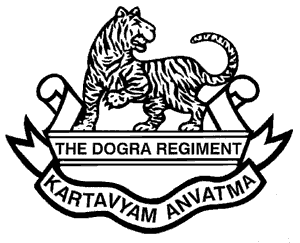
कर्तव्यं अन्वत्मा -- Duty Before Self

   Jalandhar Cantonment, 21st July of 1985: As i woke up in the morning, it was still raining. In fact it had been raining 'cats and dogs' throughout the night and as a result the water had accumulated in the neighborhood of our Army residential complex called Honeymoon Park (though this accommodation was not only meant for honeymoon couples but yes we could qualify as one such couple as we had been married for two years and did not have any issue till then). I had been allotted a two BHK terrace apartment in a two storied row of houses which was called Captains' accommodation in the Army parlance.

I came to the balcony and saw that there was knee deep water all around. In the normal circumstances i would have put on my PT uniform to attend the morning PT parade, which is normally the first routine of the daily activities of an Infantry unit, but bearing in mind the level of water on the ground, i decided to put on my gum boots and rain coat and walked out of the house.  My purpose was to visit our unit lines to see that everything was in order there. I took a round of the unit area. The jawans were busy throwing water out of their barracks with the help of mugs and buckets. That was the first time that i had seen it raining so heavily in that part of the country. Normally Punjab gets its fair share of rains during monsoons but never before i had seen the land turning into lakes and ponds due to heavy rains.

I thought of my own home at my village which was approximately twenty five kilometers away and where my parents were staying. My wife suggested that i should take leave and we should visit our village to see the condition there but i was doubtful of getting leave because things were not hunky-dory in the unit area due to heavy deluge.

While my taking round of the unit area in the morning had increased my comfort level, it also gave reassurance to the jawans of our unit to see an officer taking round of their barracks in such adverse weather condition. At the same time it also sent very positive signals to my superiors about my sincerity, as i was one of the few officers out of twenty odd in the unit, who had ventured out to take a round of the unit area. Later when i reached the office after breakfast, our Commanding Officer Col RK Sharma, called me to his office. I prepared myself to brief him about my morning round but he already seemed to know all. He started with a word of appreciation. I wanted to en-cash that opportunity to request him for giving me a day's leave so that i could visit my parents at my village. But there was something else waiting for me.

While the Commanding Officer did appreciate my having gone around the unit area in the morning, he also, in the same breath, gave me instructions to prepare my company for flood relief operations and rush to Nakodar Tehsil (Taluka) of Jalandhar District,  where a large number of villages had been inundated by flash floods which occurred because a barrage on one of the canals of the Satluj river had collapsed and given way.

After listening to the Commanding Officer's instructions, there was no question of my asking for any leave to visit my own village but, before leaving his cabin, i did mention about my desire to send my wife to visit my parents and a kind hearted person that Col Sharma was, he promised that in my absence he would arrange her visit there.

I immediately initiated the process of preparation of our company for the flood relief operations which, in addition to getting approximately one hundred and fifty jawans ready for the move, also involved collection of  Out Board Motors (motor boats) and other essential equipment from local Engineer Regiment.

I got back home to pack my personal stuff and told my wife about my next assignment. She laughed aloud without saying anything and started to prepare for the visit to our village.

By lunch time my company got ready and by evening we reached the flood affected area. For the next one week our place of stay were only our boats. It was heart wrenching to  see only the tree tops instead of cluster of houses in a large part of Nakodar Tehsil. We shifted a large number of villagers and their essential belongings to safer places with the help of our boats and other special equipment. Once the water receded in the area, i fell back to the base where i had left the administrative detachment of my company and reported about successful completion of the flood relief operations to the Commanding Officer through Wireless Set. After getting due orders from him, we returned to Jalandhar.

Later i was asked to assist the local helicopter unit to conduct an aerial survey of the area where we had conducted the relief operations on ground (or in the water, i should say). Though the flood waters had vanished, nevertheless, leaving the signs of widespread devastation with damaged houses, crops, roads and railway lines etc.

Meanwhile, in my absence, my wife had been assisted by our battalion to visit our own house in my native village. Thankfully, except for damage to some of arterial as well some link  roads, the area was more or less safe, as the flood waters had not entered villages in that area which lay north of Jalandhar.

Our company not only received due appreciation from all ranks of the Battalion for representing 10th Battalion of the Dogra Regiment popularly called 'Shaktishali Dus' in the flood relief operations, but i was also awarded Chief of Army Staff's Commendation on the occasion of Army Day, 15th January1986. On getting the news about the award, as i went to convey my thanks to our CO, Colonel Sharma, for having recommended me for the same, he smiled, tapped my left breast pocket (over which medals/ribbons are displayed) with one end of his baton and said that the award which i was getting was actually for my 'कर्तव्यं अन्वत्मा ' which is the motto of the Dogra Regiment and which means "Duty Before Self".


Wednesday, May 05, 2010

Sting Operation

This episode occurred during my Army tenure at Jalandhar sometime between 1984 and1986. I was supervising the training of our troops in the training area of our unit. It was a vast grassy field spread over a few acres with lots of trees providing adequate shade. There were a number of squad posts where the troops got their daily training in various skills as per the operational role of their sub units. 

There is a famous saying that the busiest troops are the happiest ones. Therefore, when they are not fighting, they are training, which not only keeps them busy, but also sharpens their skills in their respective fields. And one has to sweat more in peace, to bleed less in war.

After visiting a number of training squad posts, I decided to sit near one of them under the shade of a big 'sheesham' tree, around which a platform made of bricks had been built by jawans of the unit. As I was watching the actions of the Havildar Instructor who was taking a class of jawans on how to dismantle and re-assemble a particular weapon, a bright yellow colored wasp came and started hovering over one of the toes of my DMS boot. There are some insects that one will always like to keep away from and as the wasp falls in that category so, I jerked it away and as it fell on the soft muddy ground, I stumped it with my boots and forgot about it. Just then two more officers from our unit joined me and we all got busy in observing the training session.

After a while, suddenly, I felt as if some one had hit me at inner side of my thigh with a sharp knife. I jumped up with pain. The other officers were taken aback and rushed to my help. As I held my thigh at that spot, I could feel the presence of some small little object inside my pants sticking to the flesh on my inner thigh. I pressed it hard with between my fingers and thumb and there was a sound of something getting crushed. I jerked my leg hard so that the crushed object could fall out. Yes, it fell out from the bottom of my trousers and lo and behold, there it was, the same wasp that I had stumped some time back under my boots.

The Army DMS (directly molded sole) boots have deep grooves in the rubber sole which help to maintain grip while running or walking on difficult terrains, even in adverse weather conditions. It so happened that when I stumped the wasp it got stuck in one of the grooves which saved its life. It came out from under the sole and silently crept up in side my trousers and climbed as high as it could. It might have been heading for the 'ultimate target', where it would have hurt me the most but luckily due to the tightness of the pants at the thigh level it could not advance further and decided to strike with full force at that spot. Though the insect ultimately sacrificed its life, but not before carrying out a silent sting operation on me. That day in the unit training area, I learnt a great lesson that "if you leave your enemy injured, keep an eye on him, it may strike deeper than the previous target". So better kill your enemy than merely leaving him injured.


This post also forms part of the series of posts on my life's journey. To read all the psots in that series please click here.


Saturday, March 20, 2010

Wild Goose (Gas) Chase


Ladakh was by far the most eventful tenure of my Army career and i have written extensively about that in this blog under the lebel "Ladakh Memories.


From Ladakh i was transfered to Jalandhar in 1984. Since after getting commission i was moving only around the peripheral areas of the country hence, i was anxiously looking forward to this peace tenure, which was also closer home. It is another matter that after reporting to an infantry  unit at Jalandhar cantonment, i hardly got a chance to stay at home, as Punjab was reeling under insurgency and our unit was actively involved in counter insurgency operations. 


Coming back to the eventful tenure of Ladakh, even my transfer from Ladakh to Jalandhar did not go event less and one incident which marked my move was the transfer of an LPG connection from Leh to Jalandhar which i had (luckily) obtained during my tenure in Ladakh. 


Let me share it here.


When i joined the Indian Army as a Second Lieutenant in 1978 in Nagaland, some officers of my unit had suggested that I should immediately book a scooter and an LPG connection. I was told that these would stand me in good stead later, when I would raise a family. 


Those were the days when one would have to wait for minimum five years for getting one's LPG and telephone connections and same went for purchase of a scooter (particulrly, Bajaj). These things are now available off the shelf.


While I was not interested in booking a scooter (as i always fancied riding a motor cycle), I also did not bother to book the gas connection. After our unit moved from Nagaland to Trivandrum, I wasted no time in buying my Yezdi motor cycle through the Canteen Stores Department, but yet, paid no heed to booking the gas connection. After all, bachelor life had its own priorities and preferences.

Exactly five years later, as luck would have it, the gas connection came to me instead of my running around for it (though actually installing that in our kitchen at Jalandhar did give me due jitters, hence this post).


It so happened that while i was serving in Ladakh and as i was about to complete my tenure there, a new gas agency had opened up at Leh. They were giving instant gas connections. Since they did not find enough clientele in city areas, they approached Army authorities to seek customers. For the officers and Other Ranks of the Indian Army it was a God sent gift, because in other towns and cities in rest of the country the waiting period for gas connection was minimum five years, as i have already mentioned above. Without much formalities they handed out the connections with two cylinders, full of LPG and a double burner gas stove each. I bought mine.


Few months later I got my transfer orders and was directed to report to a unit at Jalandhar Cantt. When I applied for the transfer of my gas connection, I was told that I had not completed the stipulated period required before the connection could be transferred. Well, they had their own rules and I did not see any problem in taking the transfer at a later date. But since the cylinders had to be deposited back empty, along with the gas regulator, i did not know as to what to do with the LPG in those cylinders. There was no point giving them to my unit mates, who had also purchased their own connections and since they all dined in the Officers' Mess, they had no use for the gas.


I had a civilian acquaintance in the town. One Mr. Chhabra (the sikh gentleman with sky blue turban appearing in some of the pictures in my previous post) was the Lead Bank Manager of SBI. He stayed at Leh with his family. In my opinion he was the most appropriate person who could help me in getting my gas connection transferred at a later date, after my departure from Ladakh. When I requested him for the same, he happily agreed and accepted the two cylinders and the regulator along with the papers and promised that he would secure the transfer voucher and would send that to me. Of course, I carried the gas stove with me. I was relieved from the Unit and traveled bag and baggage by road upto Jammu and by rail from there to Jalandhar.

I was travelling by Jammu Tawi Express running between Jammu and Delhi. The train had one hour halt at Jalandhar city, after which it would pass through Jalandhar Cantt on its way to Delhi. My destination was Jalandhar Cantt.
Running time between Jalandhar City and Jalandhar Cantt is just fifteen minutes. I saw no point waiting in the train for one hour, just a stone's throw from my destination. So I got down at Jalandhar city and took a taxi to Jalandhar Cantt.  I reached home, freshened up and was about to start eating when Jeet enquired about the Gas connection ( i had already broken the good news of my having obtained the same at Leh and she perhaps was anxiously looking forward to cooking on LPG which was natural for any house wife). I jumped up, left the food on the table, checked my luggage and realized that I had left the gas stove in the train itself. I looked at the watch. The train would still be at Jalandhar city only. I  immediately took out my mobike, (the same Yezdi which I had bought at Trivandrum). Instead of driving to Jalandhar city i decided to go to Jalandhar Cantt railway station and wait for the train. I had barely reached the platform when the train chugged in and slowly came to a stop with its brakes making the usual screeching sound. It had just a few minutes halt there. I did not waste much time in locating the first class coach. I rushed in and went to the coupe in which i had traveled. The passengers who had traveled with me were surprised to see me again. When i told them the reason they looked amused. I looked under the berth which i had occupied. The gas stove packet, wrapped in the hassen cloth, was lying there intact. I pulled it out, once again bade good bye to the passengers and rushed back home. Jeet proudly remarked, "hard earned money never goes waste".


This far about the gas stove.


How I retrieved my gas connection is another story which required much more labour on my part.


A few months passed by and there was no news from the our friend from Leh, with whom I had left my gas connection. All this while our kitchen was running on various cooking appliances other than LPG stove. We were eagerly waiting for the transfer voucher from Mr. Chhabra. I wrote a few letters at his address but did not receive any reply. One day I learnt from one of the officers posted at Leh that Mr. Chhabra had been transferred to Srinagar. I did not know his address and wrote letters to various branches of SBI at Srinagar at random. At Jalandhar I met an officer who was serving at High Altitude Warfare School near Srinagar and whose family was staying at separated family accommodation at Jalandhar Cantt. I gave him the task of finding the address of Mr. Chhabra. He located Mr. Chhabra and sent me the address. I wrote a letter on the given address but did not receive any reply.


Enough was enough. 


I took leave and left for Srinagar. Traveling by different modes of transport, I reached Srinagar and straight away went to Mr. Chhabra's house. His wife and daughters were at home. They told me that Mr. Chhabra had left for Amritsar the night before, as his mother had taken seriously ill. I collected his address of Amritsar and reached back Jalandhar. Next day I left for Amritsar. I went to the given address and was told that Mr. Chhabra had just left for the hospital where his mother was admitted. I reached the hospital and received the same reply. That day I visited at least five to six locations in Amritsar and was told at every place that Mr. Chhabra had just left a few minutes ago. It was looking like a wild goose chase. 


Dejected and disappointed, I came back to Jalandhar. Taking leave again from a very heavily committed unit and traveling all the way to Srinagar again was out of question. I once again contacted the officer serving at HAWS, as mentioned earlier, and narrated my story to him. He promised that he would help me in getting back my gas connection. 


Sure enough, within a few days I received the transfer vouchers of my gas connection. I immediately deposited the same with the local gas agency and our kitchen started running on LPG.

Edited to add :- I did not meet Mr. Chhabra again in life and could not find the actual reason for his not contacting me or sending me the transfer vouchers with a considerable delay, but i am thankful to him because he, after all had helped me out in getting my gas connection transferred from Leh to Jalandhar after my departure from Leh. And frankly speaking, other than getting a few jitters, i did not harbour any hard feelings against the gentleman.


This post also forms part of the series of posts on my life's journey. To raed all the posts in that series please click here.


Sunday, February 28, 2010

Marriages are made in Heaven and Honeymoons...??


Marriages are made in Heaven and honeymoons ...??


Well, honeymoons are made in mountains and what better mountains one would find than those in Ladakh.


I had attained marriageable age when i got posted to a unit in Ladakh in 1982. Ladakh is one of the hardest field areas of the Indian Army. It would have been wise for a bachelor to wait till completion of the non-family-station-tenure (which ranges between two and half to three years) and get married after getting posting to a peace station. But then the marriages, as they say, are made in Heaven. Schedule for my marriage was also fixed 'Up There' and the marriage was solemnized on 20th May 1983 ie,. during the midst of my Ladakh tenure. Our Commanding officer was considerate enough to allow me to get my wife immediately after marriage to Ladakh. A few families are allowed for a limited period of time in some of the areas of the field stations. Hence, after our marriage, Jeet accompanied me to Ladakh.


We had planned our travel by road from Jammu onwards with a view to enjoying the flora and fauna on the way, but when we reached Srinagar, we were told that the Srinagar--Leh road had not yet opened. The said road closes for vehicular traffic due to heavy snow fall somewhere in September and reopens in May. As I was traveling to Leh in first week of June i did not anticipate that the road would still be closed. I had reported at Srinagar transit camp and was put up in a beautiful hut, appropriately named “Aish Mukam” (a place of joy). 


We spent our waiting period in Srinagar, going around various gardens and other places of tourist interest, checking every day about the status of Leh--Srinagar road, but the same was not showing any signs of opening for next few days. The single officers having reported in the transit camp, on their way to Ladakh, were in a position to avail the airlift by the IAF transport aircrafts but since I was accompanied by my wife, I could not do so, because families are not permitted to travel in service aircrafts. After a few more days’ wait, the formation headquarters at Srinagar decided to send the Ladakh bound officers, accompanied by their families, by Indian Airlines flight to Leh. So, instead of undergoing two days’ journey by Army bus with a night halt at Kargil, we reached Leh in less than an hour, though, as i  have mentioned above, i was in favour of traveling by road, so as to enjoy the scenic beauty along Srinagar--Leh Road.


Well, not writing any more words here, i would rather let our Ladakh photographs do the speaking, which i was able to dig out from different places and have uploaded here. For the ease of identification, i have circled myself and Jeet, wherever we are in a large group. The images can be enlarged by clicking over them.

                                                                                                         On top of the world !! with Jeet at Khardung La, the highest motorable road of the world at 18380 ft above mean sea level.


Pangong lake. The brackish water lake stretches across 160 kilometers and has an average width of eight kilometers. It attracts Siberian migratory birds, including the near extinct Black Neck Cranes. Two thirds of the lake falls under Chinese occupied area of Aksai Chin. One can enjoy boating in the lake in summers and can drive a heavy truck over it in winters.Picnic with Unit officers and their families.
Now com'n!!we  couldn't have done such a quick job to produce so many children. They belonged to the battalion officers and mostly hanged around the bride.
At Fukche, the highest Operational Airfield of the world which was put into operation during 1962 Chinese aggression.                                                                                                                                                              
"कोई सिख, कोई जाट, मराठा
कोई गुरखा, कोई मद्रासी
सरहद पर मरने  वाला
हर वीर था भारत वासी
जो खून गिरा परबत पर
वोह खून था हिन्दुस्तानी
जो शहीद हुए हैं उनकी 
ज़रा याद करो कुर्बानी" 
Memorial at Chushul, in the memory of 1962 war casualties.


Humor and high spirits are what keeps Army going in the adverse conditions too.


The ladies had organised Husbands' Nite and gave us just half an hour to wear some fancy dress and come to the Officers' Mess. We grabbed whatever came our way in our rooms and this was the result. I have circled my mug.


Tuesday, January 26, 2010

Naughty Greetings

In the Army we, the bachelor officers, used to coin naughty phrases while sending out greetings to other officers on various occasions. There are many such one liners, but the ones that merit mention here, are those, that we sent out to the officers on their weddings or wedding anniversaries. For example :-

  "HIT THE IRON, WHEN HOT" (on wedding)

  "WELL DONE and KEEP IT UP" (on wedding anniversaries, particularly to the older officers)

On my own marriage in 1983, i received a joint greeting message from the officers of my unit. I knew that this time i was at the receiving end of the naughty message. Let me share it here.

This was a full fledged Operational Order for Attack on the enemy forces. I reproduce the extracts below, though, I have hidden or modified some text, which contained battlefield terminology or some hard core adult material.

OPERATIONAL ORDER FOR ATTACK

Enemy Force: - Consists of a beautiful, young girl, escorted by a number of hostile females in the age group of sixteen to sixty years. However, the enemy forces are likely to include some male members too.

Own Force:- Consists of veterans of various age groups, led by a budding young officer of the Indian Army, who is capable of achieving any assigned task. Friends will accompany only for moral support. The objective remains to be captured single handed.

Flanking Forces:- One male, younger in age to the leader of the mission, from his own family, will march on the left flank and one heavy weight and an experienced male member from the leader’s friends’ circle will march on the right flank, however the final assault will be undertaken by the leader of the mission himself.

Attachments and Detachments:- All the bridal attires and ornaments will be detached from both the forces at the right movement.

Topography of the Objective:- The coordinates of the General Area are 36-24-36. The area has various curves and slopes which have to be delicately negotiated during the operation. Use of supporting arms is restricted. The objective will have to be captured with the help of personal weapon only.

Weather:- Expected to be hot and humid, owing to the heat and perspiration generated during the encounter of opposing forces.

Likely Pattern of Operation:- To be decided by the leader of the mission in accordance with development of final situation.
MISSION
To capture the objective 'Jeet' as early as possible, but other small objectives en route, to be neutralized with due care and delicacy.
EXECUTION
Attack will be in two phases

(a) Phase one: - To cut off the enemy from all sides and deny reinforcements.

(b) Phase two:- To force the enemy for an unconditional surrender.

Force Multiplier:- Perfumes, and soft music.


Air Support :- Since the operation is taking place in the month of May, Air Conditioning of the battle field will be ensured by the supporting arms.

Coordinating Instructions:- The battlefield will be decked up with flowers etc., to achieve desired ambiance for the operation.

Target Illumination :- No direct light to fall on the target. Only diffused lamps will be used during the whole operation till the capture of the objective.

Logistic Support :- Hot milk and dry fruits will be dropped in advance at the area of operation. No supplies will be made during the operation.

Success Signal :- Full lights off in the battle field after the capture of final objective, however, no other success signal will be fired as hundred percent success is expected.

Gallantry Awards :- Citation for award of a male or a female child  will be immediately forwarded to the Highest Headquarters, once the mission is accomplished.

Wish you a happy wedded life.


-- Officers of the 'Mighty Third'

This post also forms part of series on my life journey. To read all the posts in this series, please click here.


Friday, January 01, 2010

Where Were U on New Year's Eve?

Thank you BlogAdda for choosing this post for your 'Tangy Tuesday Picks'

And thank you IHM for recommending this post for the same.
Where did you spend the 'New Year's Eve' -- the much awaited and much celebrated event, which people enjoy in different ways, at different places, most of the times indulging in fun and frolic, dance and dinners. And why not because the first day of the new year is the culmination of the festival season which starts with Ganesh festival, Navratras, Dussehra and Diwali and Eid in India (depending on which part of India you are) and with Christmas in the rest of the world. It is a day to celebrate and people all over the world do it in different ways.

I have also enjoyed the new years' eves in many different ways and at many different places during various stages of my life. I have fond memories of many of them but i can never forget the night between 31st December 1983 and 1st January 1984.

Ours was the last vehicle to cross the traffic check post (TCP) on the road leading to Changla pass -- the second highest motorable pass of the world after Khardungla. The Indian Army personnel donning the red beret, belonging to the Corps of Military Police (CMP), deployed at the check post, waved our vehicle to move ahead and thereafter dropped the pole barrier not to allow any more vehicles to undertake the upward journey towards the pass.

I had come back after spending a short leave at home with my family which included my parents, my newly wedded wife and my sweet little sister (who now is an ardent follower of my blog and whose comments are frequently found on my blog posts).

Having reported at my Unit Headquarters at Leh, i was further moving to my sub unit deployed on the Indo China border near Chushool. Since no dedicated vehicle was available for going to my company location, i had to take a lift in a vehicle which was moving from our unit to that location, carrying some supplies.

It was a Shaktiman -- a transport vehicle used for transporting troops or supplies from one place to the other-- popularly known as ' Three Ton' in the Army parlance. You can spot this vehicle, with a squarish looking bonnet having sharp edges with "SHAKTIMAN" written on the radiator mesh, plying on the Indian roads in cantonments etc. It is also used some times even in the form of a make shift school bus with chairs or benches fitted in the body of the vehicle, carrying wards of Army personnel. The vehicle has a small driver's cabin with a large body covered with tarpaulin which can accommodate a load weighing up to three tons, as the name suggests. Though the seat in the driver's cabin can accommodate three persons but in any Indian Army vehicle, only one person is permitted to sit beside the driver. The personnel of the CMP are meant to keep an eye on that aspect. They regulate the movement of Army vehicles at various places in the field as well, as at peace stations. In our vehicle, in addition to the driver, there were two more jawans from our unit who were sitting behind in the body of the vehicle.

The TCP was located at precisely the place from where the vehicles had to negotiate a steep zigzag climb to reach Changla pass. The climb takes a few hours, depending on the category and load of the vehicle -- lighter ones taking less time. After reaching the highest point ie., the pass on the formidable mountain range, the road starts its descent which goes down in to the valley on the other side. Both sides the TCPs are located at the similar locations ie., the start and end of the steep ascent and descent respectively.

As our vehicle was winding its way up, we could, at times, have the glimpse of the vehicles on the mountain slope, moving up in a convoy which had left the TCP before us.

Suddenly, our vehicle made a funny coughing noise and came to a halt. The driver got down, opened the bonnet, fingered some parts under the bonnet cover as per the drill taught to him and came back and started the vehicle. We resumed our arduous ascent once again.

After going a few kilometers further, the vehicle again acted in the same manner. The driver once again repeated the action and the vehicle again started its upward journey. The gap between our vehicle and those moving ahead of us, was gradually increasing, owing to our vehicle stopping frequently due to the engine problem. On the way we also met the convoy coming from the opposite direction.

The sky was overcast with thick clouds and in Ladakh one could never predict when snow fall would start, particularly during the winters.

Our vehicle drove smoothly for a few more kilometers up the slope and then again it broke down. This time the driver could not hide the embarrassment on his face. As he got down and went to the front of the vehicle to open the bonnet cover, i got down to straighten my limbs. As i stretched my body and looked up towards the top of the mountain range, i could not see any vehicles on the hill slope. We had wasted quite some time in fixing the engine problem while the other vehicles had continued their ascent and had gone out of sight. Moreover, the mountain tops were now all hidden under thick clouds and perhaps, it was snowing on the pass. The driver fixed the problem and once again we resumed our uphill drive. We encountered the snow fall on the way which kept increasing in intensity as we approached the pass.

By the time we reached the pass, it had grown dark and the snow fall was continuing. The pass had already received a few feet of snow as it must have been snowing there for quite some time. The driver halted the vehicle to give rest to the engine as well, as to check the recurring problem before we could resume our downward journey. The snow flakes were getting thicker in size every minute. There was an idol of Lord Shiva, installed in a small makeshift temple hut on the hill side of the pass. It was a custom that anyone crossing the pass would get down and pay respect to the Lord. I also climbed the steps leading to the temple and took a bow before the Lord's idol. Just then the winds started blowing hard and as i was coming down the steps, i was pushed back by the winds, flying snow flakes into my eyes. A full fledged snow storm was building up. As i reached and got into the vehicle, the driver dropped the bonnet cover and got behind the steering wheel. He started the vehicle but it did not start. He made many attempts but the engine refused to crank. He opened the door to get down to look up the problem again but the sheer velocity of the wind did not allow him to do so. I told him to stay back inside.

The snow storm was getting fiercer every minute. The visibility had gone down to zero. The very high velocity winds were making whistling sounds while brushing along the parts of our vehicle.

The driver looked at me with a helpless look on his face. I smiled back at him. The vehicle was not starting. We were stuck on top of Changla pass at the height of 17500 feet above m.s.l. There were two alternatives before us. First one was to leave the vehicle and walk down to the TCP, which would take another few hours, bearing in mind the adverse weather condition. Walking in zero visibility at night during a snow storm on steep hill slope could lead to our loosing the way and fall into some snow cavity. The snow covered hill slopes at times can be very deceptive, showing false surface and one could accidentally step into a deep cavity covered with snow, thinking it to be a level surface.

The second alternative was to spend the night in the vehicle and walk down to the TCP the next day. The risk here was spending almost twelve hours at a place where the oxygen contents in the air were very low, owing to low atmospheric pressure at that height. Also the high velocity winds were tearing into any object that stood there on the pass.

I chose the second one. Howsoever fierce the snow storm was, we were well ensconced inside our vehicle.

I asked the driver to see if the jawans sitting behind in the body of the vehicle were comfortably covered or otherwise call them into the driver's cabin. The driver opened the small window slit, provided at the back of the driver's cabin and shouted in local lingo. Both the driver and the other jawans were Ladakhis as our battalion had local troops. One of the nunnus (the Ladakhi boys are called so), shouted back that they were comfortable. The jawans always carried their sleeping bags issued to them. The back opening of the vehicle was also having tarpaulin cover, which they must have tied in place.

I was wearing the full set of my winter clothing, which included many layers of cardigans like string vest (a vest woven with thick cotton strings to prevent sweating inner wears clinging to the body, which can later cause pneumonia, once the sweat cools down), woolen vest, angola shirt, woolen jersey, coat parka with a hood and a balklava ie., the woolen monkey cap. I also wore snow boots with woolen socks and woolen pants with woolen under pants. Despite all this i could feel that while the upper portion of my body was feeling warm, the legs , particularly the knees were going numb with cold. The driver, who was also wearing the same set of clothing, also felt that our knees needed to be covered. He took out his sleeping bag from the box under the seat and we spread the same on our legs to keep them warm.

After some time, as i started feeling drowsy with sleep, i told the driver that we both could not sleep at the same time and would sleep in shifts, one person at a time. The purpose was to keep an eye that our vehicle, though, having sufficient height, should not get covered under snow blanket. I told the driver that we would open our side doors at regular intervals to jerk away the snow, which was accumulating outside, so that we could open the doors in the morning with ease. The driver told me that he had a kerosene stove in the vehicle which we could light for keeping the driver's cabin warm. The drivers always keep such things handy just to prepare tea etc., on long stretches of drive as well, as to warm their food on the way. I did not allow him to light the stove because, though, it would warm up the cabin but it would also burn up and deplete whatever little oxygen was available in the closed cabin.


The front windshield had become an opaque glass sheet, as the snow and frost had formed a thick film on it from outside. However, the side glass panes remained transparent as we were moving the doors off and on to keep the door opening intact.

After midnight the snow storm subsided. I opened the door on my side. It opened with a great difficulty as the snow had covered the space outside up to half the height of the vehicle. I had to literally push it with my feet, while sitting on the seat. I made an attempt to come out of the vehicle by removing the snow outside, again pushing it away with my feet. It made some opening for me to crawl out. A little more effort made the opening wider. I came out and had a look around. It was all absolutely calm. There was nothing else visible except snow all around. The temple hut of Lord Shiva had gone under the snow blanket. I dug my feet in the soft snow and went a little away from the vehicle and released my self, leaving a pale yellow hole in the snow, which was now shining bright under the starlit sky. Driver had also opened the door on his side. I went to the back of the vehicle. The jawans inside were snoring away to glory.

Both driver and myself came back into the cabin and closed the doors. We decided to catch some sleep now as the sky had become crystal clear, showing even the tiniest of the stars and there was no possibility of any more snowfall.

We woke up with the day break. I told the driver to stay back with one of the jawans and asked other one to accompany me. I took out my rucksack which, in addition to carrying my essential stuff, also had a packet of 'pinnies' (the balls made with the flour of 'moong' pulse, sugar, jaggery, dry fruits and many other nutritious ingredients, which my mother always prepared and gave me whenever i came back from leave. Two of such 'pinnies', if taken in the morning could see one through up to lunch time). I shared some of them with the jawans, before starting our ghost walk (in six feet of snow, one has to literally walk like a ghost lifting the leg high up before again digging it in the soft snow ). Though, the TCP was visible in the valley but it took us almost four hours to reach that spot. The snow cutters were on the job for clearing the road for traffic, which were expected to reach the pass by lunch time.

The TCP- in- charge told us that they had known of our getting stuck on top of the pass, as the two TCPs on the two sides remain in contact with each other to keep a tab on the number of vehicles sent and received by each of them. They told us that they tried to send a rescue party to help us come down from the pass but that could not go any further than a few meters due to the snow storm.

We were driven to the brigade headquarters where the Regimental Medical Officer (RMO) Dr. Maj Sharma carried out our routine check, like blood pressure etc. He smiled and said "Balli, though, i had written you off but you seem to have emerged as fit as the local Ladakhis"

We exchanged new year wishes, as it was 1st January and i left for my company location to celebrate new year with the jawans who were anxiously waiting for my arrival.

In the Indian Army, when an officer connects with the troops at such special occasions by attending the festivals, their religious functions etc., they are ready to die for you.

And wish you all a very Happy New Year 2010.


This post also forms part of series on my life journey. To read all the posts in that series please click here.


Thursday, July 16, 2009

The Pony Race

In the Indian Army, whenever the raising day or the battle honour day of a unit is celebrated, it is marked with a few functions, like Sainik Sammelan (the senior most officer of the Unit or the Regiment addresses all Ranks), Bara Khana ( lunch or dinner with the troops combined with some cultural programmes presented by them), Lunch or Dinner in the JCO's Mess and Dinner in the officers' Mess. But one of the most interesting events of the celebration is the 'Pagal Gymkhana'. This consists of various games and sports by officers JCOs and other Ranks and their families. Some of them are really crazy like sack race, three leg race or potato race etc hence the prefix 'pagal'.

It was the raising day of my unit in Ladakh which was also attended by the locals from the nearby villages in large number. We had planned a pony race by officers of the unit for the 'Pagal Gymkhana'. Since the Animal Transport was the integral part of the unit, we had our favorite ponies. We had to take two rounds of the perimeter of a ground equal to the foot ball field to complete our race. Another interesting part of any Army function is that there is always a full dress rehearsal a day or two in advance to ensure the precision of timings (there is a story about a Subedar Major who had taken his son's marriage procession to the bride's village a day in advance sending the bride's family into panic, only to be relieved when the ' Barat' turned back from the border of the village and told that they were conducting full dress rehearsal for the marriage procession).

On the day of the full dress rehearsal, as our race started, I found that after completing one round of the field I was leading the race by almost half the length of the perimeter. My nearest competitor was left far behind and every body in the spectators' gallery was cheering me up. The race finished and I was the cynosure of all the eyes during the tea break. I told the Nunnu (the young boys of Ladakh are called so) looking after my pony to take care of it properly so that it would repeat the performance on the final day of the race which was the next day.

During the final events of the 'pagal gymkhana' when the pony race was announced the participating officers came to the start point and our respective ponies were handed over to us. All the ponies were looking great but mine was the centre of attraction as it had shown great performance the previous day. The race started and as expected I took the lead and left the nearest follower far behind. But after completing one round of the field my pony suddenly changed its direction and cut across the field diagonally and made a beeline for the stable which was at a little distance from the ground. I tried all types of stunts to bring it back to the racing track but all in vain. It crossed the cheering crowd and went and stopped inside the stable. There it started defecating. I came back to the field leaving the pony in the stable. Now the crowd was jeering at me as I walked across the field with the thin flexible stick in my hand. I joined the spectators in the officers' enclosure who consoled me and told me to take that sportingly. Later the Nunnu told me that he had fed some energy food to the pony to boost its strength. Perhaps he gave it an over doze.


This post also forms part of series on my life journey. To read all the posts in this series please click here.

Wednesday, July 15, 2009

The Drifting Parachute

That was the northern most post of the Indian Army and I had the proud privilege of being its post commander in 1982. The post was entirely air maintained, implying, that rations were air dropped and the mail was delivered by the helicopters, which were also used for evacuation of personnel due to ill health or otherwise. The nearest habitation or vegitation was about eighteen days foot journey or pony ride away. So the sight of the aircraft high up in the air and of the chopper at the helipad were the most pleasant ones for the troops. However, clear skies were the biggest precondition for both such sights.

That day was a bright one, which meant, that the air drop was possible. As expected we heard the sound of the aircraft and in a short while it could be seen orbiting on top of our post. The dropping zone was always kept marked, yet, the aircraft took some rounds over the post giving ample time to alert the troops below to clear the dropping zone, as also, for lighting smoke candle there to indicate to the pilot the wind direction at the DZ. We came out of the bunkers to look at the parachutes with the payload swinging in the air, coming down slowly and finally settling on the ground with a thud. Some times some parachutes did not open properly and came down swiftly crashing their contents on the dropping zone. These were called candled parachutes owing to their resemblance to a burning candle (the payload and the strings representing the body of the candle and the white cloth of the unopen parachute wavering in the air like its flame while coming down at a great speed).

That day also the drop was normal with some parachutes not opening and hence crashing down on the DZ. But to our surprise one parachute despite having opened fully did not show any sign of coming down and instead, was drifting away from our location. As I got curious I told the Company JCO to get the horses immediately. We followed the flight of the drifting parachute and found it at a distance of about two to three kilometers from our post. It had ultimately dropped down and had settled in the middle of a small dry lake. On closer examination we found that there were some cans of kerosene oil kept in a wooden crate but the same were empty. Since the load was not enough to pull down the fully open parachute it had drifted away from the dropping zone.

Later I found out from the reliable sources that a small group of personnel in the supply unit responsible for packing and loading the rations in the aircraft indulged in regular pilferage of rations. Their modus operandi was to partially empty the contents of some of the cans/boxes containing mostly attractive items in a particular parachute and give it some faulty knot so that it would not open and would crash its half filled contents on the dropping zone, thus not raising suspicion about any malpractice. But in the case of our drifting parachute firstly, they must have emptied the contents of all the cans of the crate as was evident from the empty cans and secondly, they also forgot to give the wrong knot to the parachute, as a result of which it opened normally but refused to come down at the designated place. I had also observed that the crashing parachutes invariably contained items like condensed milk, eggs, liquor or oil etc. Never did a parachute carrying the grass fodder for the horses and mules crash.

The group was caught and punished severely as they were not only indulging in pilferage in one of the cleanest organizations of the country but were also being cruel by stealing the kerosene oil of those troops who had to warm their bunkers with that oil at a place where the temperature dropped down to minus 50 degree Celsius.


This post also forms part of series on my life journey. To read all the posts in this series please click here.


Tuesday, July 14, 2009

Divine Intervention


Leh-- 1982. I was to receive a senior officer at Leh airfield and accompany him to the Formation Headquarters for an important meeting. I instructed the driver, first thing in the morning, to keep the 'Jonga' (Army version of an SUV) ready. I rang up the local ATC (Air Traffic Controller) to check the ETA of the Aircraft. I was told that since there was bad whether at the originating airfield, there would be some delay in the arrival of the flight from its normal time. Therefore, instead of going and waiting at the Airport which was about fifteen to twenty minutes drive from our unit, I decided to go to the office first and wait there. The office was walking distance from our Mess where I was staying. As I was walking to the office, I heard some ringing in the air. It was the sound of an AN --12, the Indian Air force transport plane. I looked towards the sky. Though I could not see the aircraft, I knew that it was fast approaching.

My sharp sense of hearing was one thing that I could really boast of and the credit goes to a magazine which i had read way back during my school days. It had carried an article that described as to how one could improve one's five senses. Out of the five, I had tried on the sense of hearing first, the method of which was the easiest. (As per the instructions given in the magazine, while lying down on the bed at night, one should first listen to the sounds in the immediate vicinity without concentrating on the origin of the sounds, subsequently widen the radius of the concentric circles and then listen to the sounds emanating from farther and farther). Having practised that for some period of time, I could feel that my sense of hearing had improved to a great extent and I flaunted the same quite often by telling about a faint or a distant sound which I had heard but others had not.

Although, that day, this ability of mine had helped me to hear the sound of the coming Aircraft early but the notice period was not good enough that I would reach the Airport well before the landing of the same. However, since the 'Jonga' was readily available in front of the office with the driver waiting there, I started right away.

As we made an exit from the unit area and joined the main road, I could see the aircraft right above our heads. My driver looked at me. I nodded, and he pressed the gas pedal harder. The road ran parallel along the Indus river which flew in the opposite direction. The aircraft had started gliding over the river. It had already over taken us and would land in a few seconds. The visiting officer would look for me at the tarmac itself after disembarking. My absence there would cause embarrassment to him as well, as to me and my unit. It was my fault to have decided to wait in the office instead of going and waiting at the airport itself. I had no option but to close my eyes and recite the prayer which I do every morning.

The aircraft had crossed through the two low lying hills at the edge of the runway, which the pilots called India Gate which actually formed a sort of gateway to the runway for the incoming aircrafts. It was about to make its touch down, when its engines suddenly started accelerating. I looked towards my right where the runway was visible from the road. The aircraft had flown past the runway, picking up height again. It went into its orbit and after making a full circle over the town, it landed after good about ten minutes. By that time I was at the tarmac, ready to receive the visitor.

Later I found out that as the aircraft was about to land, an ambulance had suddenly come on the runway, forcing the pilot to abort landing.

Was it the ambulance ?


I call it the Divine Intervention attributed to my prayers ?

This post also forms part of series on my life journey. To read all the posts in this series, please click here.


Tuesday, June 16, 2009

Kanya Kumari to Karakoram

After Trivandrum my next stop was Ladakh as i was transferred there, however, i also spent considerable amount of time in Rajasthan before moving to Ladakh.
The memories of Rajasthan take me back to the unending stretches of sand dunes which we had to traverse during the course of our battle simulation exercises. The most difficult part of any military operation in the deserts is keeping correct directions as there are no landmarks to guide one through the sandy desert. Most of my memories of Rajasthan pertain to our operational exercises, hence, not being shared here.


In February 1982 i moved to Ladakh. 


 Change of Shoulder Badges in a simple ceremony. Doing the honours are, Col Balbir Singh, Commanding Officer and Major Gupta Second-in-Command (now a retired Brigadier) while the Other Ranks look on.


While in Ladakh look as Ladakhis do. The officers can connect better with the troops by adopting their culture. Self in Ladakhi dress in one of the Unit functions.


My entry into Ladakh was marked by a tragic incident. I have written about it in the previous post. 


Having been born and brought up at Shimla, i felt at home during my Ladakh tenure. As it is said that 'the experience counts', my skill in ice skating which i had learnt at Shimla helped me in assuming the charge of our ice hockey team as team captain. The boys in our team were local ladakhis therefore we had no problem beating all the teams which visited Ladakh to participate in ice hockey tournaments.


Receiving individual prize and the team championship trophy from General Rodrigues who was our Divisional Commander at that time who later became Chief of the Army Staff. (Pictures can be enlarged by clicking over them)
The ice hockey matches were so popular that the locals from nearby villages used to descend on the venue of the tournaments and would watch the game from the roof tops.


This post also forms part of series on my life journey. To read all the posts in this series, please click here


Friday, June 12, 2009

The Legend Lives On

In continuation of my previous post, let me share some more interesting facts about Col Babbar's life as sent to me by his grandson Mr. Neerav.


Col HKS Babbar was born in a hindu family in Lahore, now in Pakistan. His mother often visited the city Gurudwara(a Sikh shrine). Once she fell very seriously ill and a Granthi (a Sikh priest) from the gurudwara came to see her. He told Col Babbar's father to devote the eldest son to the Gurus. Col Babbar, aged 14 or 15 years at that time willingly became a sikh and grew his hair. He studied at Khalsa college Lahore where he was elected as the president by the students. The principal of his college was so impressed by the persona of this young man that one day, while addressing the students of the college, he called him on to the stage and gave him the title 'BABBAR' (synonymous with LION). Thus he changed his name in the official records from Hari Krishan Singh Dewan to Hari Krishan Singh Babbar. The principal was the one who persuaded him to join the Indian Army. Before leaving for the military training his mother took a promise from him that he would never drink and gamble. He was known to be a staunch teetotaller in his friends' circle. No one ever dared to force a drink on him. When he joined Indian Military Academy he would find it rather difficult to manage his hair. He would take a lot of time in tying his turban and would always get late for the morning drill (as he was not born in a sikh family so he was not trained properly in tying a turban). One day he took permission from his mother and went to the Gurudwara, apologised before the Granth Sahib and got his hair cut. Despite that he didn't change his religious belief and remained a true Sikh and lived a life based on the principles of Sikhism. His wife and children remained the followers of the Hindu faith.

Mr. Neerav says that he was told this story by his grand mother when one day, many years back, they all were going through the family album. The album contained Col Babbar's photographs in turban during his initial days in IMA.

Thursday, May 28, 2009

Inheriting the Soldierly Spirit

I would like to share a response from Mr. Neerav, who responded after reading my blog. Mr. Neerav is the grandson of Col HKS Babbar about whom i had made a mention in the comment window of my earlier post "So Far SO Good"

Mr. Neerav's response :-

Dear Sir,

I am very grateful to you for holding my grandfather in such high regard. I feel that he belonged more to his regiment than to us. Thanks so much for your kind words for my grandad. He has been my role model since childhood, but to my misfortune just when I was a grown up boy and wanted to learn and take a lot from him, we lost him. He left for heavenly abode in 2002. I have heard a lot about him from various people. It was an honour for our family when General NC Vij along with other senior officers flew from Delhi to attend his funeral at Meerut.The fact that the Chief of the Army Staff came to an officer's funeral who had retired almost 25 years back as a Colonel made me realise how much he is/was respected in the army. All funeral arrangements were made by a Dogra TA Battalion stationed at Meerut. It was somewhat like a state honour. We owe a lot to the Dogra Regiment which gave him so much of respect and honour during his last rites. My grandmother often told me as a child of my grandfather's experiences in Nagaland, and also about the true story of an award on his head by the naga chief. My grandad was full of humility and was such a humble man that he never made me or anyone in the family feel of his greatness that he had earned. We always heard of him from others acquainted to him. He was a man of principles and belonged to a breed that is rare to find today. There is a small article published in The Tribune by an officer who was known to my granddad. The title is 'Soldierly Spirit', here's the link to this article
http://www.tribuneindia.com/2007/20071120/edit.htm.
I once again thank you sir from the bottom of my heart for your kind words about my granddad on your blog. I look forward to a correspondence with you.

Warm Regards,

Neerav

I was so much impressed by his response that i wanted to share the same with my blogger friends and therefore asked for his permission to do so. I once again received the following reply from him :-

Dear Sir,

My granddad once said to me that the biggest daan(in hindi) is Gupt Daan. If you do some thing good never boast about it. Keeping in view his principles, I am, as his grandson a little hesitant to boast about him on your blog. I'm comfortable talking about him to people who knew him. As far as you are concerned, you were known to him professionally, and u are completely free to write about him as you shared a strong regimental relationship with him.

Warm Regards

Neerav

I was so much touched by his responses that i decided to publish them here. Reading the replies of Mr. Neerav, one can certainly conclude that this young man has truly inherited the "Soldierly Spirit" of his Grand Pa and is sure to emulate Col Babbar's principles in his own life.