Showing posts with label Faith. Show all posts

Monday, February 23, 2009

The Haircut

I told Dilraj, who was scanning the Sunday newspaper supplements, to go and have a haircut. " No papa, I am growing my hair", he replied promptly without looking up. Growing his hair ? To what length ! I wondered and took another look at him. Some faces came to my mind like John Abraham or Dhoni. May be that he was inspired by one of them. So I decided to keep quiet. My mind took me back to my childhood days.

A sikh boy, I had very long hair, almost up to the waist level. I had grown up with my hair tied on top of the head, kept in place with the help of a white handkerchief (as some athletes and hockey players do). During the cultural functions in our boys' school, our maths teacher , who was also the organizer of such functions, invariably gave me the female roles, and I dare not disobey him because I was not very good in maths. So I had the distinction of having acted as mother, wife, bhabi, sister and so on.

As soon as I got the first signs of some beard on my chin, I, thankfully, stopped getting the female roles and the white handkerchief gave way to 'Patka' (Harbhajan style) . I started wearing turban when I entered the college. Although the turban suited me well, and my friends called me a smart sardar, yet, I always craved to keep short hair. I used to stand in front of the mirror and would cover my hair bun with my hand to assess as to how would I look with shorter hair.

One day I was on my way to the college along with my friends, all of whom had short hair. It was warm by Shimla standards. I annonced that I felt like having a haircut. They all looked at me in amazement but finding me serious, they approved my plan. I asked them to accompany me to 'Bright Hair Dressers", one of the best in Shimla at that time which was located right opposite the Scandal Point. ( and I did not know that this was going to be the second biggest scandal, at least for our family, the first one being Maharaja Patiala eloping with daughter of the then Viceroy to his palace at Chail, hence the name of the spot).

When I told the hairdresser that I needed a haircut he was dumbstruck for a few seconds, just examining me from top to bottom as if trying to establish the truthfulness of my statement. When I insisted, he made me sit in the chair, carefully took off my turban, opened and combed my long hair, once again confirmed my desire and then proceeded with his scissors. I told him to put the long tresses in a packet along with the turban, collected the same and proceeded to the college. I received various types of comments there, in particular the frowns from my sikh friends. However, I did not realize that I had done something very wrong until I reached home. My Mother nearly fainted when she opened the door to let me in. Within minutes our house was swarmed by sympathising neighbours, some of them consoling my mother and few others passing comments in my support. The congregation dispersed only when my father came home from office. His face looked so grave with anger that the gathering decided to leave rather than witness something unpleasant. His first question was that which girl had coaxed me to undertake this act of sacrilege. My mother even offered to leave home , I dont know for where.

I grew my hair again.

It was only ten years later, when I was undergoing the 'commando course' at Infantry School , Belgaum, that I took permission from my parents to keep short hair. I was finding it extremely difficult to maintain longer ones during the toughest training course of the Indian Army meant for all officers of the Infantry Regiment.

My wish was granted and they also agreed to my keeping short hair permanently thereafter.
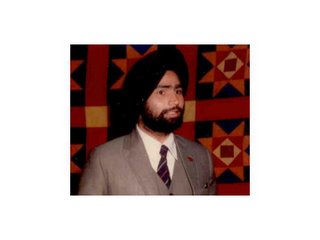
Before


and


After

This post also forms part of series on my life journey. To read all the posts in this series, please click here.


Tuesday, August 26, 2008

The Articles of Faith

The followers of various religions, cults and faiths sport various articles in the form of :-
robes,
dresses,
rings,
bracelets,
bangles,
head gears,
daggers,
swords,
marks on the forehead,
facial and skull hair,
rosaries,
threads around wrist, biceps or torso,
turbans and scull caps


and many more which have been invented from time to time as symbols of faith. Unfortunately the articles of faith take precedence over the faith itself. The devotees are so attached and feel so touchy about such articles that they forget the true essence of the faith that they are following. They often fight with the establishments, in case these articles are required to be removed due to security or other reasons which sometimes even leads to bloodshed too. There is a very fine example of clash between true faith and the article of faith in the story given below which was doing the rounds on the net some time back.

There was once a climber who attempted to climb a very high mountain all alone. After many days of difficult climb, up the vertical cliff, when he was about to scale the summit, his foot slipped and he fell down deep into the gorge. It was night time. As a trained climber, he had made sure that he was secured with the help of a safety rope. As he was suspended in the air, tied to his safety rope, he tried to look below but could not see anything as it was pitch dark. He, naturally, remembered God and prayed for his life. A voice called out to him from the mountains and asked him to cut his rope. He was further dejected as he felt that, it was perhaps the devil's voice asking him to cut his rope so that he died instantly. He kept hanging there through out the night in the sub zero temperature. Next day when the rescue teams arrived, they found his lifeless frozen body, hanging with help of the safety rope, just a few feet above the ground.

Similarly our articles of faith are like those safety ropes to which we cling more dearly than the faith itself. In trying to maintain our grip over these articles we loose our grip on the true meaning of faith. While there is no harm in having our own safety ropes, which may provide us the psychological comfort, let us not forget that there is someone more powerful than these safety ropes, who is guiding us to safety all the time.

Only we have to Listen to HIM.

Friday, June 20, 2008

The Hidden Eye

Recently i read in Renu's blog that when one goes to a shopping mall or any other public place and finds out that some hidden camera is watching us, one remains more cautious of one's actions. One avoids doing something wrong. The cameras act as deterrent. She further wrote that if we realise that there is an eye which is constantly watching us, the world will be much nicer a place. Yes that is true.

The picture given below was received in my mail and is supposed to have been taken by some space camera. It may be that of some phenomena in the space. But to me it looks like God's eye which is watching us all the time from above. What is your opinion ??.


Wednesday, December 05, 2007

The Head Gear

I visit a Gurudwara (Sikh shrine) on Sunday mornings more or less on a regular basis and some times also in the evenings. The congregations are held twice a day at predesignated time. I try and reach the place well in time to avoid walking in at the fag end of the proceedings.

One day when i went to the Gurudwara to attend the evening session, i got considerably delayed due to some unavoidable reasons. I parked my car and hurried up the slope leading to the shrine. As I was mentally preoccupied not to miss the 'Ardaas' -- the final prayer of the day-- which was about to start, I forgot to cover my head. One has to keep one's head covered in the presence of Guru Granth Sahib (the Sikh holy book) as per the Sikh 'maryada' (tenets). The covering of head particularly in Hindu, Sikh and Muslim religions is associated with paying respect, though the members of some communities in India as well, as in some other parts of the world, take off the head gear and uncover the head to pay respect.

Inside the Gurudwara that I had entered bareheaded, the 'Granthi' (priest) was reciting hymns from Guru Granth Sahib. As I was taking a bow before the holy book, he looked at me through the gap between his eyebrows and the rims of his spectacles giving me a stern look. I could not interpret the meaning of his look. As I was walking back to take my seat in the gathering, I saw a few devotees frowning at me. One of them, who was sitting in a corner and was busy reading the extracts of Guru Granth Sahib from a small booklet called 'Gutka', independently of the proceedings going on in the Gurudwara, rushed out to fetch a small piece of cloth for me to cover my head. In most of the Gurudwqaras generally the cloth pieces, properly done up in square or triangular shapes, are kept on a stand for those bare headed devotees, who may like to use them for covering their heads. By this time one of the devotees pointed towards my head and I realised my mistake and promptly took out handkerchief from my pocket and covered my head. I sat down amongst the devotees with embarrassment writ large on my face. I knew that I was in for an admonishment from the priest as well, as from some self styled moral policeman at the end of the proceedings.

The 'Granthi', completed the necessary rituals of the 'Ardaas' and the 'mukhwaak'. Mukhwak is a shloka which is read out by the priest from the holy book at the end of the prayers, popularly known as 'hukamnama' or the divine order. After the distribution of 'prasad', the ' granthi' who was respectfully called 'Baba Ji' by the devotees, came straight towards me and sat down. Some other devotees were still present there. Generally for the evening sessions, the number of devotees is far less as compared to the mornings. As i prepared myself to listen to the moral lecture, he started narrating a story to us.

Once Majnu, the lover boy of the 'Laila Majnu' love affair fame, was on his way to meet his beloved Laila. He was so engrossed in his thoughts about meeting her that he nearly bumped into a person who was offering 'Namaaz'(the Muslim way of offering prayers at designated time by spreading a sheet and facing the westerly direction at any convenient corner of even a public place, in case there is no mosque nearby). The man stopped his 'Namaaz' in between and ran after Majnu and asked him that why he had crossed in front of him and had disturbed his 'Namaaz'. Majnu, who was also a Muslim, promptly apologised and explained that he was so much lost in the thoughts of his beloved that he did not even notice that some one was offering 'Namaaz' there. But in the same breath Majnu asked the 'Namaazi' that if he was offering his prayers with true devotion, then how did he notice that some one had walked in front of him. The 'Granthi' then went on to explain further that when we pray, we should connect with the Divine in true sense of the term and should not bother about our surroundings. Citing the example of Majnu in the story, he told the audience that Majnu's love for Laila was more intense and sublime than the 'Namaazi's devotion for God.

After finishing his sermon he looked meaningfully at the person who had rushed outside to get the cloth for me to cover my head and once again gave me a glance, but this time with a smile.
I felt relieved.

Tuesday, September 18, 2007

Faith or Superstition ??

There is a thin line between faith and superstition. In this land of diverse religions and cultures, one man's faith is likely to be another one's superstition. Most of our religious practices and rituals are purely based on mythology. Most of the mythological stories, which we have learnt from our parents and teachers or from our books about our gods and goddesses, are devoid of all logic and reasoning.

It took a small girl of fifth standard to ask her mother that if King Kansa (the maternal uncle of Lord Krishna) had come to know that he will be killed by the progeny of his sister Devki then why did he put her and her husband Vasudev in the same prison. The mother told her to shut up. But when she repeated the same question to her teacher at the school, she got the reply that "during those days no copulation was required to produce children".

As children, we have lots of questions to ask, but over the years, as we grow, we tread along the beaten track and in turn our thinking gets so conditioned that we ask no more questions. Moreover since those stories, characters and rituals are connected to the faith of many people, we avoid asking questions, lest we may hurt some one's religious feelings.

The characters and incidents mentioned in our epics are so weird that one is forced to believe that their authors must have used a great sense of imagination to make them more interesting and readable. After a few centuries or so, our offspring may be told that an angel walked this earth between 1869 and 1948, in flesh and blood who, without firing or throwing a single projectile, drove away his enemy -- the white demons -- who had deceitfully and forcefully occupied his motherland and ruled over it for more than three hundred years. Well, while that is a reality, most likely in times to come, the story of Mahatma Gandhi may be presented by some author or a film maker by adding such special effects that the readers or the viewers will be forced to believe that he was the reincarnation of God. Already a feature film has been successfully made where the Mahatma appears as a hallucination, whenever the hero remembers him. That is exactly how the gods and goddesses are believed to have appeared before their devotees, whenever the latter were in trouble and prayed for help. Though the makers of 'Lage Raho Munna Bhai' have made a successful attempt to tickle the funny bone of the audience, but somewhere between the lines they have tried to drive home the point that our gods are in our minds. We can get their guidance whenever we desire so from the core of our hearts. The God is in fact our conscience.

While it is a fact that if two persons think, there is bound to be some difference of opinion, because if everybody thinks alike then no one thinks enough, but at the same time it also gives rise to controversies which some how, we Indians love. The moment some controversy -- religious, political or social one -- surfaces, the whole country erupts into war of words. One contentious song or a dialogue in a movie, a statement in a book, a painting by some artist, or an action by the Government, different groups pounce on the occasion to extract different derivatives as per their selfish interests i.e., the vote banks for the politicians, rioting and communal disharmony for the disruptive forces, loot and arson for the hooligans and above all the viewership for the Television Channels.

One such dispute doing the rounds these days is about the Ram Setu or the Adam's Bridge. The bridge is an extension of the two mainlands of India and Sri Lanka in form of small narrow strip of land stretching across Palk Straits in the Indian Ocean. Government of India wants to create a passage through the said strip to make way for the ships which, while travelling between east and west coasts, have to skirt around Sri Lanka due to want of such passage at present, spending much more fuel as well as time. However, a group of people are vehemently resisting such efforts because they feel that this extension is not a natural phenomena, but is a religious monument, which was built by Lord Ram with the help of 'Vanar Sena' (the monkey force) to cross over to Sri Lanka. They feel that the Government's action would destroy this monument and in turn, would hurt the sentiments of some people.

In my opinion, if Lord Ram was to resolve this dispute today, given the sense of sacrifice and justice that he exhibited in his every action, he would have ordered the same 'vanar sena' who built the bridge, to create the passage through the Setu for the Ships to pass, because that is the need of the hour. Lord Ram's purpose of building the bridge was served, the moment he crossed over to Sri Lanka and freed his wife from Ravan's captivity.

Let us give due respect to each other's faith, but let us also be careful that the maintenance of such faith does not harm others or it does not come in the way of doing something good for the mankind.


Notice the thin line under the water, joining the two mainlands of India on the right and Sri Lanka on the left. That is Adam's Bridge or the Ram Setu, stretching across 30 kilometers. The picture was taken by NASA satellite

Tuesday, June 12, 2007

'Amrit' the Elixir of Life

‘Amrit’ means the elixir of life. One is believed to attain immortality after having partaken the same. The ‘Devas’ and ‘Danavas’ (the gods and demons of Indian mythology) both fought for it and churned the ocean for obtaining the same.

However, the meaning of 'Amrit ' has remained as elusive as 'Amrit' itself.

Recently there was some controversy and commotion in parts of the northern Indian states, where the leader of a particular sect was shown in advertisements, practising the ritual of giving ‘Amrit’ to his followers, a ritual, believed to have been practised by Guru Gobind Singh, the tenth Sikh guru, when he laid the foundation of the 'Khalsa panth'. The practice is now being continued by the Sikh clergy to initiate Sikhs into 'Amritdhari' ones and make them so called 'puran gursikh' (the complete Sikh).

Guru Gobind Singh had taken up arms against the Mugal Emperor Aurangzeb , who was forcibly converting Hindus and Sikhs to Islam and committed tortures and atrocities on them if they resisted. In the fight against the Mugals, his family members, including his four young sons and his father, Guru Teg Bahadur, the ninth Sikh Guru, sacrificed their lives. To fight the strong force of the enemy, Guru Gobind Singh had to raise an army of brave men and women, drawn from all sects of society. In the year 1699, he laid the foundation of Khalsa panth at Anandpur Sahib, where he called for a large gathering in which he first invited five men on the condition that they should be prepared to die for the sake of the country. The five came forward and the Guru baptised them by giving them 'Amrit' and called them "Panj Piyaare" (the five beloved). 'Singh' was added to their names which later became the second name of all the Sikhs. Even the name of Guru Gobind Singh was Gobind Rai till that day. After that others followed and thus, a small beginning turned into a large army of self sacrificing men and women and also gave birth to the first classless society in the country. The Sikh soldiers were given a dress code for the ease of fighting as well, as for distinction from the enemy forces. These were :-

i) Kesh (long unshorn hair carefully tucked under the turban)

ii) Kirpan (a sword as a personal weapon)

iii)Kangha (a wooden comb to be kept tucked in the hair)

iv) Kara (a thick iron bangle, perhaps as a safeguard of the forearm in a sword fight)

v) Kachhehra (a garment stitched in a particular fashion, resembling short pants for ease of running).

Each of these items had significance in the battlefield and suited the life style of the Sikh soldiers, who had to stay on the battle front for long periods. Even to this day, as a mark of respect and tribute to the sacrifices made by the Sikh Gurus and other Sikh martyrs, the five items, as mentioned above, are being worn by most of the Sikhs religiously and followed more stringently by the 'Amritdhari'. However, there are other Sikhs and non Sikhs who, though do not actually follow the said dress code in its complete form yet, follow the principles of Sikhism ie,.

i) 'naam jappna' (to repeat the name of almighty all the time so that all our actions are guided by Him)

ii) 'vand ke chhakkna' (to share with our brethren whatever we get to eat) and

iii) 'kirt kamaayee' (to earn ones livelihood by the sweat of one's brow).

Guru Nanak Dev, the first Sikh guru, laid the very foundation of Sikhism to rid the society of false religious pretences and rituals. He had a unique way of sending his message across to his disciples and the public in general. Once he deliberately lied down at a famous religious place, pointing his feet towards the sanctum sanctorum. When asked by the priest to move his feet away from the seat of the Allah, the Guru requested him to move them towards the direction where the Almighty did not live. The priest was speechless. Guru Nanak Dev had driven home his point that the Omnipresent does not live within the four walls alone. On another occasion, after watching pilgrims offering water to the Sun on the banks of Ganges, he started throwing water towards the opposite direction. When questioned, he told, that he was trying to irrigate his fields, which were hundreds of kilometers away. He argued that if the water could reach the Sun then why not his fields. Every single verse of ‘Guru Granth Sahib’, the holy book of Sikhs, calls upon us to shun affectations and follow the teachings of the great gurus and saints which repeatedly mention that God is only one ('Ek Onkaar').

Over the centuries, the Sikhs have been identified as a brave and hard working race. They have not only been providing largest quantity of food grains to the country, but have also been contributing largest number of manpower to the Indian Army. By their sheer grit and hard work, they have converted many a barren land, in some parts of the country, into green farms, particularly in some desert and hilly areas. They have achieved success in almost every walk of life and have migrated to almost every part of the world. This is one community, the members of which, owing to their great sense of humour, have the ability to laugh at themselves. The Sikh functions are designed to be simple and sober. In Sikh marriages, no horoscopes are matched to find the brides and the grooms. The marriage is held on any convenient day selected by the families of the bride and the groom, mostly Sundays, without getting into the rigmarole of 'Muhurats' etc. The marriage is solemnised by taking four rounds of the holy book ie., 'Guru Granth Sahib' by the marrying couple during day time preferably before twelve. However, now most of the Sikhs have started indulging in the 'spirited' revelry during almost all the functions in addition to adding all kinds of pomp and show in a race to compete with one another.

While the Sikhs have become synonymous with hard work, bravery and high spirits, they have also demonstrated tolerance and humility. In a ‘gurudwara’ (a Sikh shrine) all are welcome, regardless of their cast, creed, colour or culture. At the end of every religious congregation, all sit on the floor and eat together, as a mark of equality of mankind. Guru Gobind Singh, a military General par excellence, a great writer and a poet was known as ‘Sant Sipahi’ ie., saint soldier.

The recent show of strength by Sikhs, where they were seen marching in the streets, brandishing bare swords and other weapons, destroying public property and disrupting normal life, in protest against the incident as mentioned at the beginning, was just unfortunate. The Sikhs have been ordained to raise the sword, but only in the face of extreme injustice, being meted out by the strong and powerful to the feeble and helpless. Guru Gobind Singh wrote :


" सूरा सो पह्चानिये, जो लड़े दीन के हेत" ' soora so pahchaaniye jo ladey deen ke hait' (the brave is identified as the one, who would fight for the interest of the poor)

In today's strife torn world, the need of the hour is universal brotherhood, tolerance, peace and harmony, that is demanded time and again in the ‘Gurbani’ -- the teachings of Sikh gurus and other great saints from different religions like Kabir , Farid, Namdev, Jaidev, Ravidas etc, recorded in ‘Guru Granth Sahib’, which is worshipped as the embodiment of the ten Sikh 'gurus'.

So far as the meaning of ‘Amrit’ is concerned, let me quote from 'Guru Granth Sahib' itself :


"ਅਮ੍ਰਿਤ ਨਾਮ ਪਰਮੇਸ਼ਵਰ ਤੇਰਾ
ਜੋ ਸਿਮਰੇ ਸੋ ਜੀਵੇ "


“अमृत, नाम परमेश्वर तेरा,

जो सिमरे सो जीवे ।”


"amrit naam parmeshwar tera,

jo simrey so jeevey"


‘Amrit’ is thy name oh Almighty!

The one who bears it (in the mind) lives on.”